
Invited Talk at the International 6G & Beyond Experts Workshop in Bochum: Cooperative End-to-End Automated Driving as a 6G Service
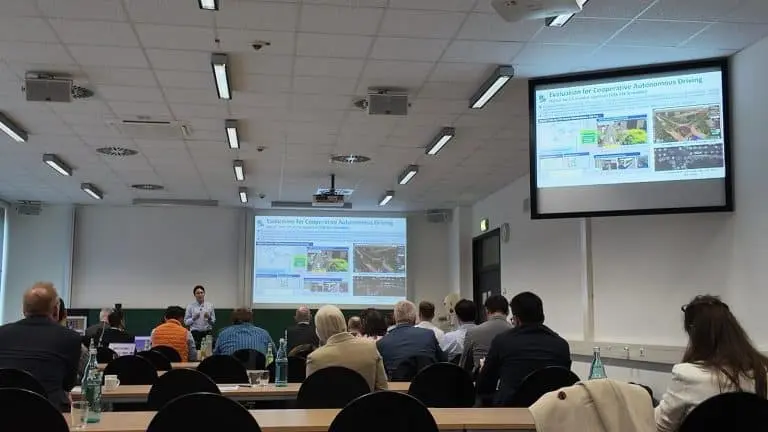
On 6 October 2026, the International 6G & Beyond Experts Workshop was held in Building ID of Ruhr University Bochum (RUB), Germany, under the motto “Shaping 6G: From Vision to Value”. Organized within the 6GEM+ transfer hub at RUB, the one-day, single-track workshop brought together experts from telecom operators, technology vendors, cloud and AI companies, and academia around one practical question: what should 6G become, and how do we turn its ambition into useful technology, architecture and services? Assoc. Prof. Manabu Tsukada gave an invited talk in the afternoon session on 6G services.
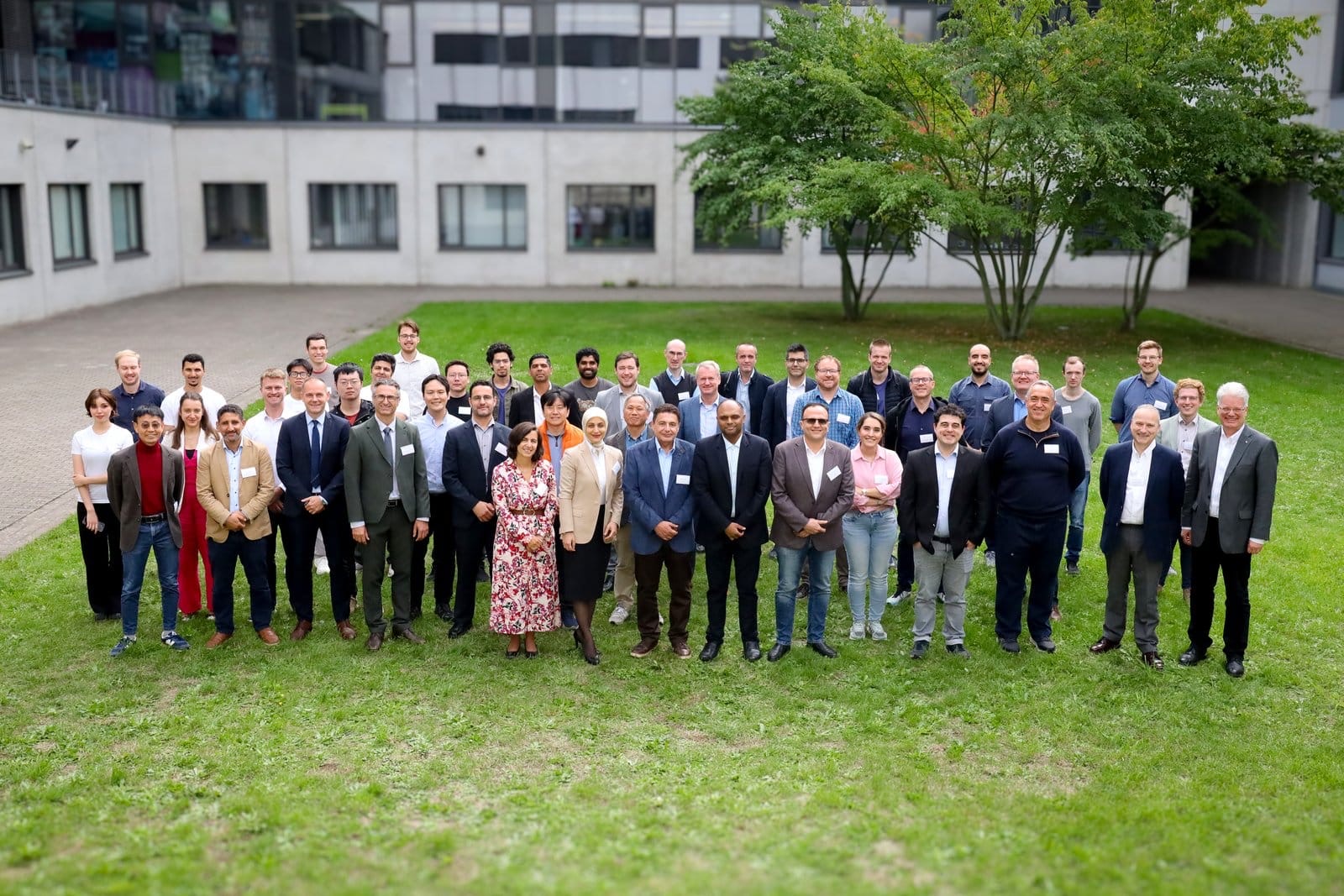
Speakers and participants of the workshop (photo: MOSAIC Lab, Ruhr University Bochum)
The Workshop and Its Four Questions
The programme was framed by four questions. AI-native networks: how will AI reshape network design and operation? Openness and programmability: how open and programmable should future networks become? Communication and computing: how will communication, computing and cloud converge? And services and value: which new services will genuinely require 6G, and what must the network guarantee to enable them? The Workshop Programme Co-Chairs were Prof. Aydin Sezgin and Prof. Tarik Taleb of RUB, with Dr. Qize Guo (RUB) as Local Organizing Chair.
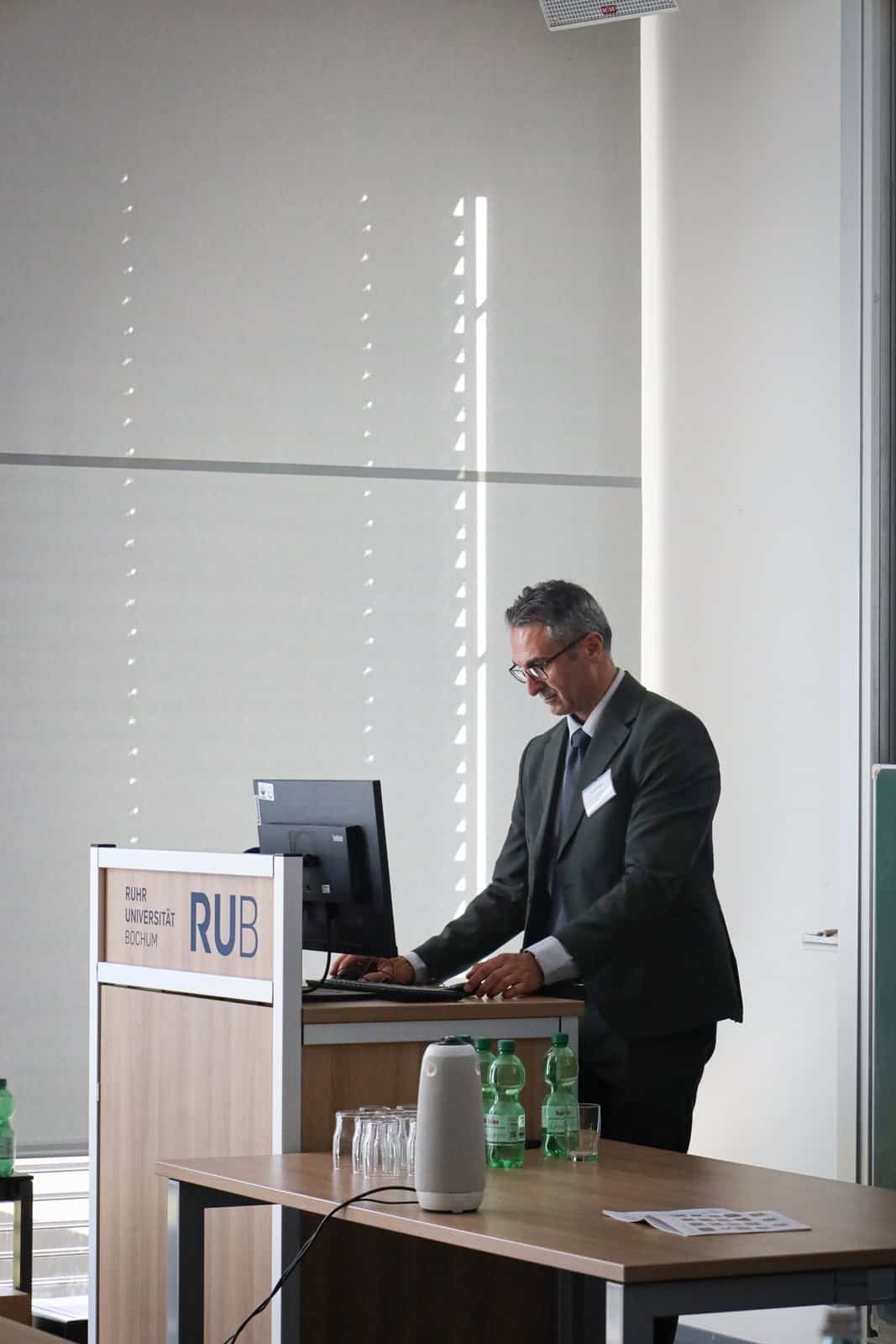
Opening of the workshop at Ruhr University Bochum (photo: MOSAIC Lab, Ruhr University Bochum)
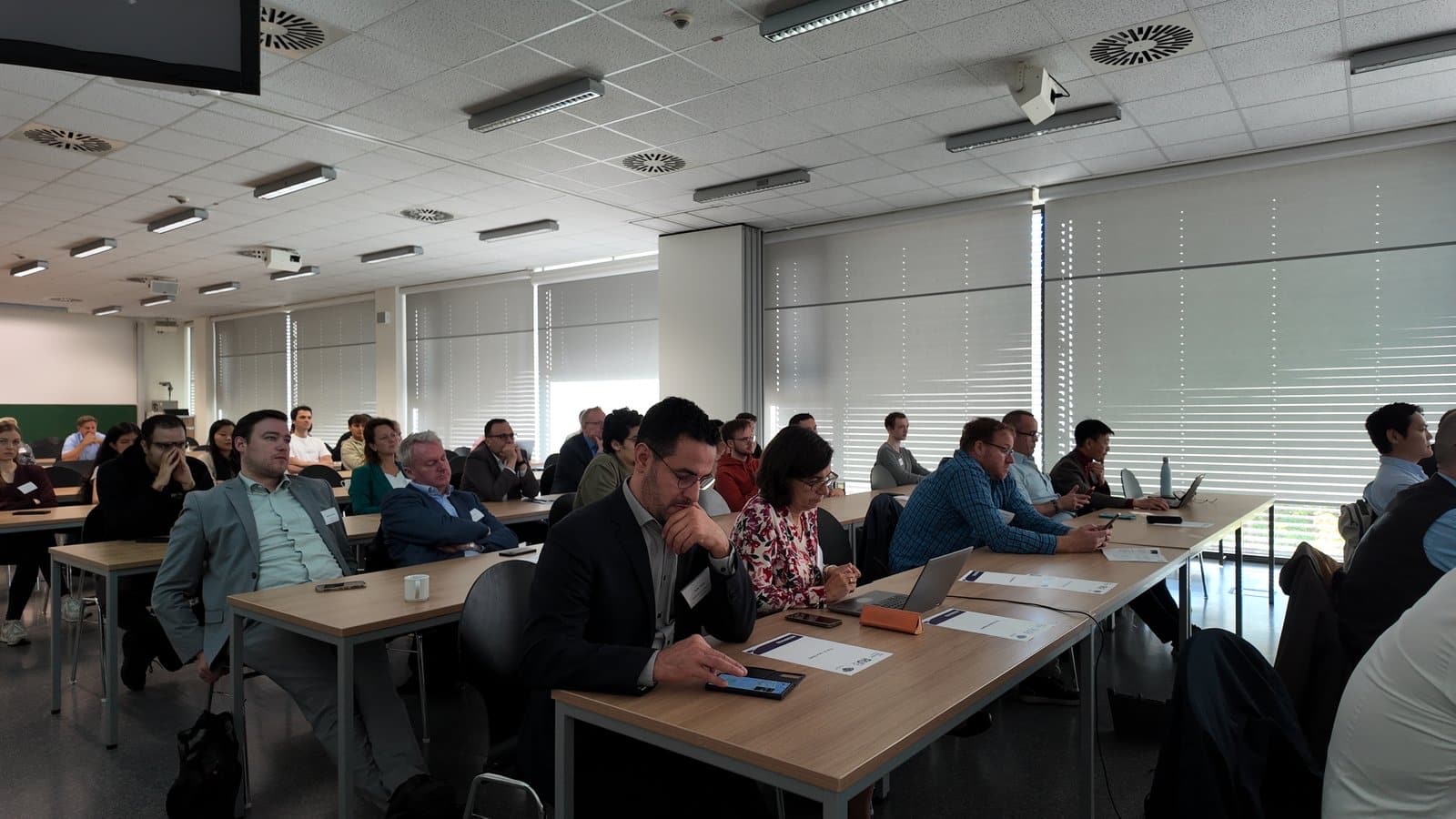
The lecture hall in Building ID (photo: MOSAIC Lab, Ruhr University Bochum)
Sixteen speakers took the stage across two keynote sessions and two technical sessions. The keynotes and the morning session, “6G & Beyond Enablers & Features — Perspectives from Industry”, gave the floor to VIAVI Solutions, Rakuten, T-Labs, Nokia Bell Labs, Keysight Technologies, DOCOMO Euro-Labs, Cumucore, Cloudera, 1&1 Versatel and Telefónica Germany. The final session, “6G & Beyond Services — Perspectives from Academia and Startups”, brought speakers from Sejong University, the University of Aveiro, the University of Tokyo, RUB & PHYSEC and Montsecure.
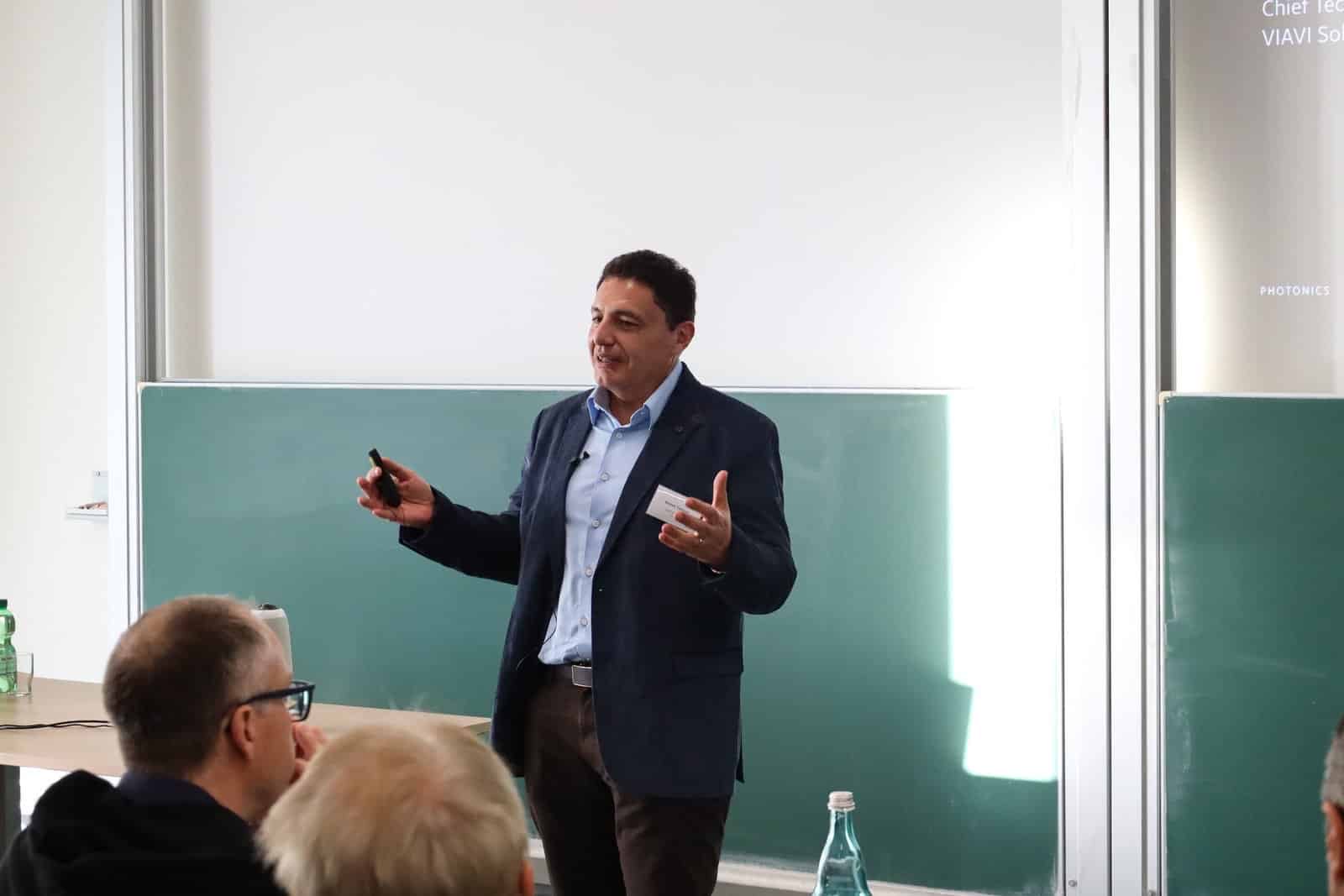
Keynote by Dr. Sameh Yamany, VIAVI Solutions (photo: MOSAIC Lab, Ruhr University Bochum)
Invited Talk: What Should the Network Carry?
Tsukada was the third speaker in Technical Session II, welcomed by the chair as “Professor Manabu Tsukada from the University of Tokyo”. Before turning to 6G, he began with an invitation: “So now I invite you to ITSC 2028 in Tokyo, two years later. It is the biggest academic conference in the ITS area.” He asked the audience to submit papers and proposals to IEEE ITSC 2028.
His talk, Cooperative End-to-End Automated Driving as a 6G Service, started from a familiar claim. Cooperative automated driving is often cited as a 6G use case, but the interesting question, he argued, is not how much bandwidth it needs; it is what the network should carry. In the rule-based era, V2X carried messages standardized by consensus, such as CAM, DENM and CPM, on cycles measured in years. In the end-to-end era, vehicles and roadside units want to share learned internal representations — features, semantic occupancy and intent — that are vendor specific, latency critical, and useless unless the receiver can align them with its own model.
Intent was where the argument became concrete. He said: “The problem was not the perception. It was the misread intent.” “So intent sharing,” he went on, “is a very important issue.”
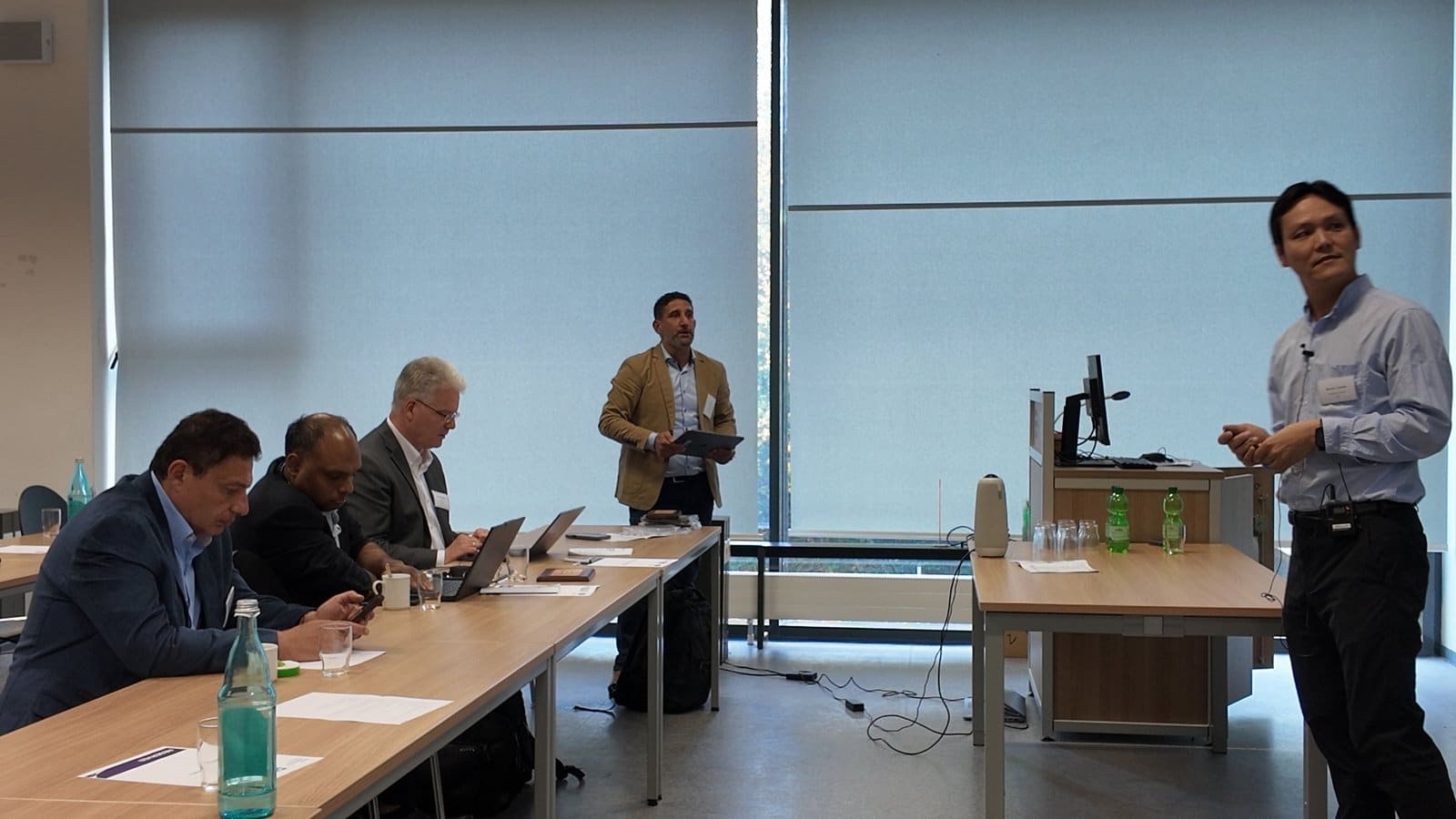
Tsukada’s talk in Technical Session II (photo: MOSAIC Lab, Ruhr University Bochum)
Drawing on the lab’s field deployments and open-source work — AutowareV2X, Level 4 cooperative driving in Kashiwanoha, the Co3SOP collaborative occupancy benchmark, and a digital-twin evaluation platform that combines Autoware, AWSIM and network simulation — the talk derived four requirements that cooperative driving places on 6G:
- value-aware transport that degrades gracefully;
- deadline-aware joint communication and computing;
- inference-time interoperability between heterogeneous agents;
- verifiable trust in shared beliefs.
He closed with the JST CRONOS programme, which treats foundation models as the lingua franca between vehicles, infrastructure and people, and with an invitation to shape these requirements together — an answer, from the automated-driving side, to the workshop’s question of what the network must guarantee.
Beyond the Sessions
The coffee breaks were busy with discussion, and a drone demonstration ran during the breaks. Around lunchtime, speakers and participants gathered outdoors for the group photo shown above. Every speaker received a speaker’s plaque on stage. The day ended with the workshop dinner, held in a restaurant with a brick-vaulted dining room.
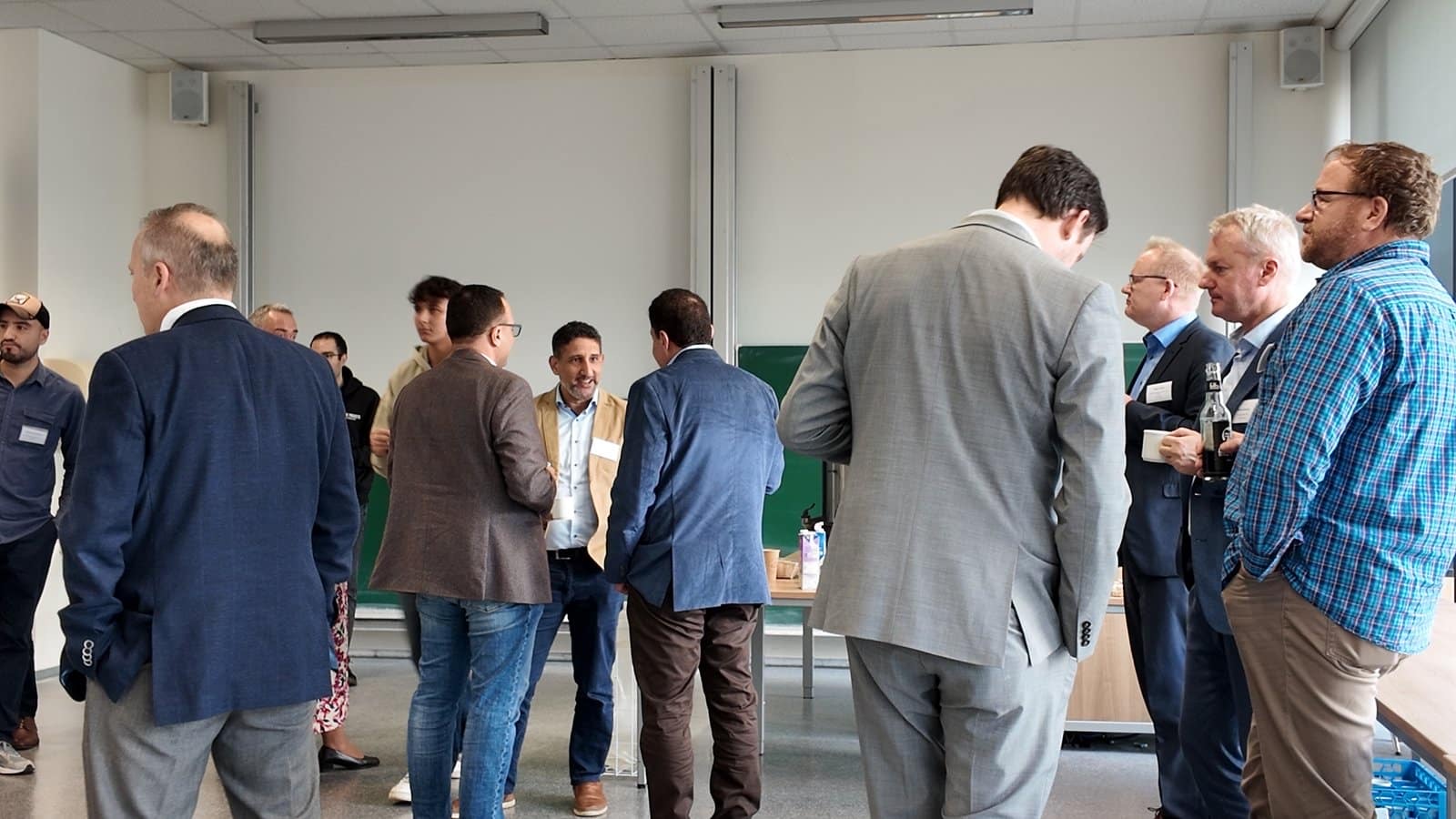
Discussions during the coffee break (photo: MOSAIC Lab, Ruhr University Bochum)
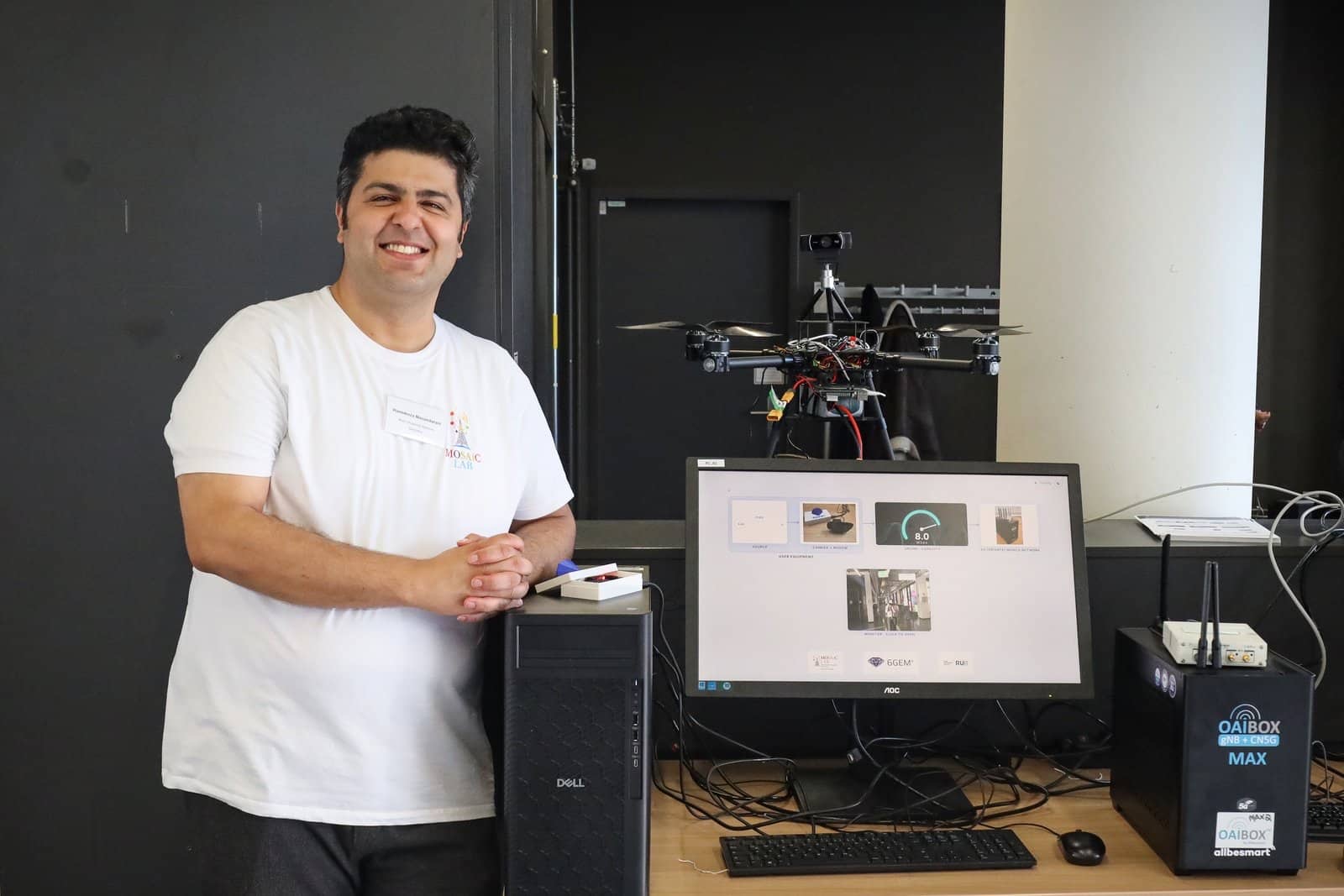
A drone demonstration during the breaks (photo: MOSAIC Lab, Ruhr University Bochum)
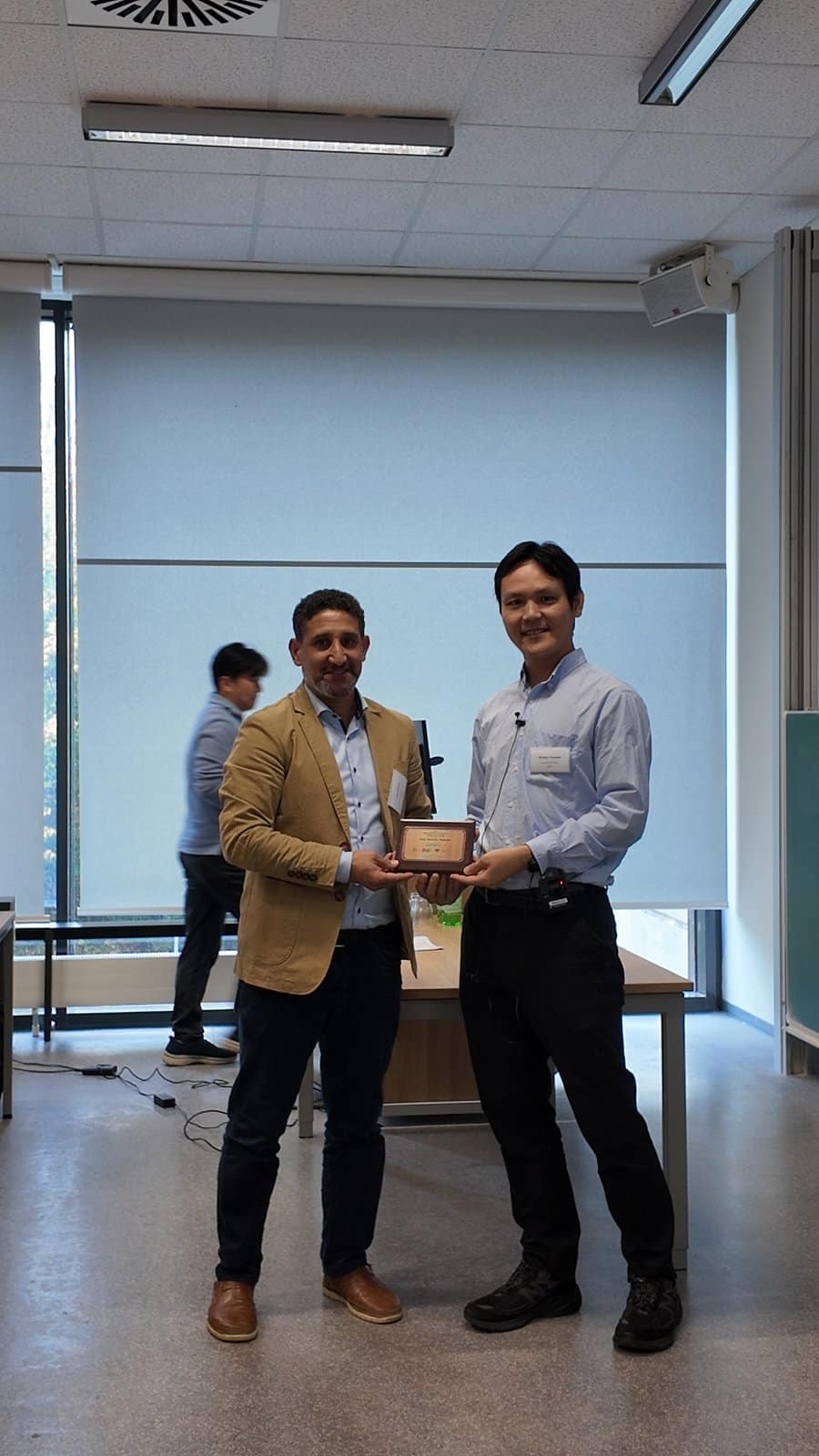
Tsukada receiving the speaker’s plaque (photo: MOSAIC Lab, Ruhr University Bochum)
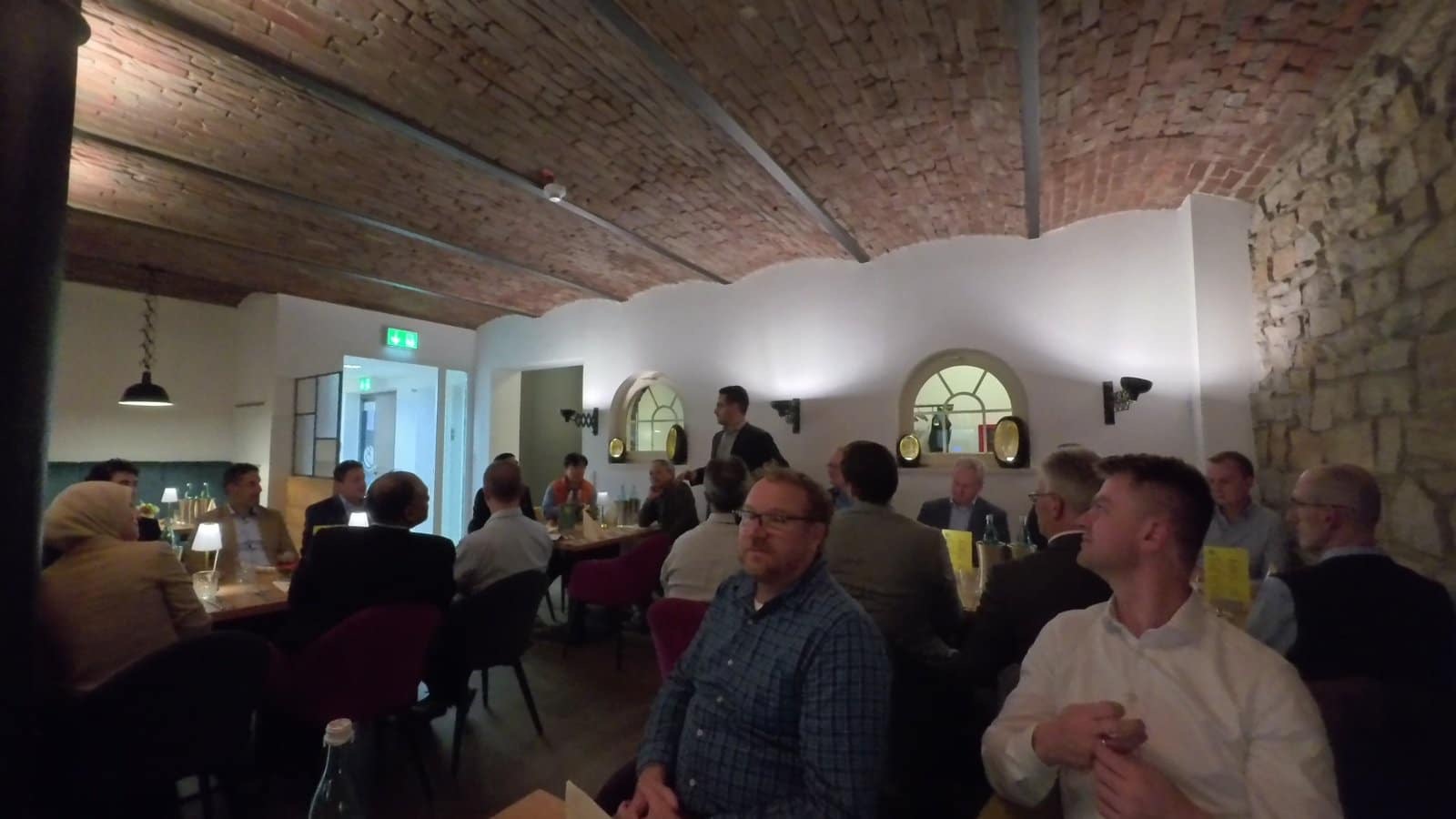
The workshop dinner (photo: Tsukada Lab)
Publications and Presentations
- Cooperative End-to-End Automated Driving as a 6G Service
Tsukada, Manabu. Invited talk at the International 6G & Beyond Experts Workshop, Technical Session II: 6G & Beyond Services, 6GEM+, Ruhr University Bochum, Germany, Bochum, Germany, 06.10.2026 [Presentation]BibTeX
Workshop website: https://6g-net.org/